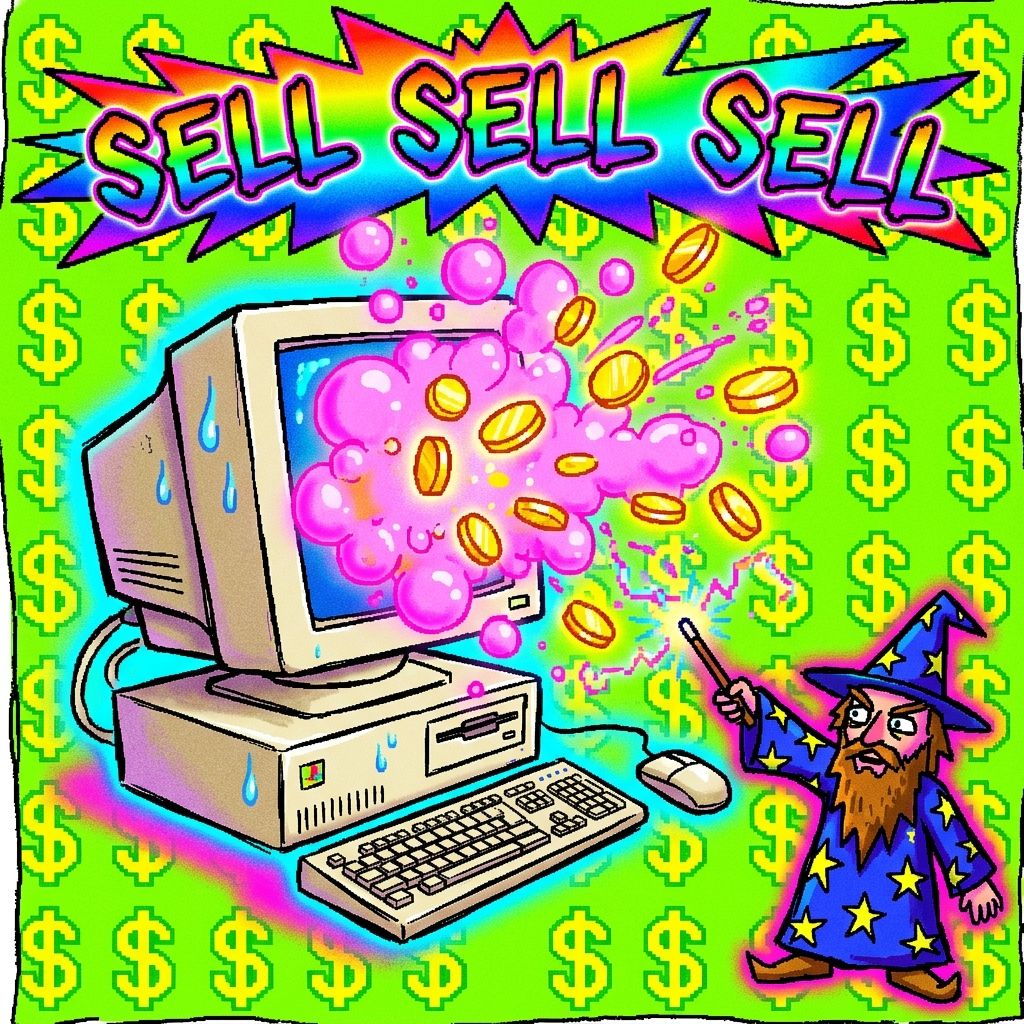
The Math is Mathing in All the Wrong Ways
Listen closely, because the suits at Capital Economics are trying to tell us something through the thick fog of their own panic. John Higgins, a man who probably dreams in bar charts, has pointed out that while the price-earnings ratio for AI stocks has already taken a nose-dive from its peak, there is another, much spookier monster lurking in the shadows. We are talking about a 'rare' kind of bubble, the sort of financial anomaly that only happens when everyone collectively decides that reality is optional. It is like watching a magician fail a card trick but then somehow convince the audience that their wallets disappearing was part of the show.
The traditional metrics for measuring success in the tech world are currently about as useful as a chocolate teapot. We were told that AI was going to solve every problem from climate change to why my socks always disappear in the dryer, but so far, all we have gotten are chatbots that confidently tell us that stones are a vital part of a balanced diet. Despite the P/E ratio collapsing, the gap between what these companies are actually worth and what people are paying for them is widening like the mouth of a hungry shark. It is a rare bubble because it defies the usual gravitational pull of common sense, floating upward on a cloud of pure, unrefined hopium.
Sentience, Stocks, and Shouting at Clouds
I recently tried to explain the concept of an economic bubble to my smart toaster, and it responded by burning a crude image of a middle finger into my sourdough. This is the level of sophisticated technology we are betting our entire global economy on. Higgins notes that a bubble usually happens when share prices soar despite a lack of evidence for actual financial results. It is the financial equivalent of a 'vibes only' party where nobody brought any snacks, but everyone is convinced there is a five-course meal coming any second now. We are living in a digital hallucination where the value of a company is determined by how many times their CEO can say the word 'synergy' without blinking.
If you look at the history of bubbles, they usually pop with a whimper and a lot of sad LinkedIn posts. But this 'rare' AI bubble feels different. It is fueled by a desperate need to believe that we are on the verge of a technological utopia, even while the actual software struggles to distinguish a chihuahua from a blueberry muffin. The economists are sweating through their starch-pressed shirts because they know that when the 'intrinsic worth' metric finally catches up to the hype, the resulting splash is going to be visible from space. It is a high-stakes game of musical chairs, and the music is being composed by an algorithm that thinks human ears are located on our elbows.
The Final Countdown to the Big Squeak
So, what do we do while we wait for the inevitable burst? Some people are doubling down, buying up every scrap of AI-adjacent stock they can find like they are collecting rare Pokemon cards. Others are retreating into the woods to live in a yurt and communicate exclusively via smoke signals. Personally, I am just enjoying the spectacle. There is something truly poetic about watching the most advanced civilization in history get tricked by its own math. We built the machines to predict the future, and the machines told us that everything is fine while the house is clearly on fire.
The rare bubble isn't just a financial phenomenon; it is a symptom of a society that has forgotten how to value anything that isn't represented by a glowing pixel. We are trading real-world stability for the promise of a digital god that can summarize an email thread for us. When the bubble finally pops, it won't just be the investors who feel the sting. It will be everyone who thought they could automate their way out of being a person. But hey, at least the memes will be top-tier while the economy does a triple-flip into the abyss. Just remember to save your work before the blue screen of death becomes a permanent fixture of the New York Stock Exchange.
Conclusion
In the grand scheme of things, whether it is a price-earnings ratio collapse or a rare metaphysical bubble of sheer hype, we are all just passengers on a glitchy bus driven by a neural network that thinks a stop sign is a delicious pizza. The economists will keep drawing their lines and shouting about ratios, but the rest of us will be here, waiting for the inevitable moment when the big needle of reality finally meets the shiny skin of the AI dream. Keep your wallets close and your analog calculators closer, because the next pop is going to be loud, weird, and probably involve a lot of digital confetti that you can’t actually use to pay your rent.