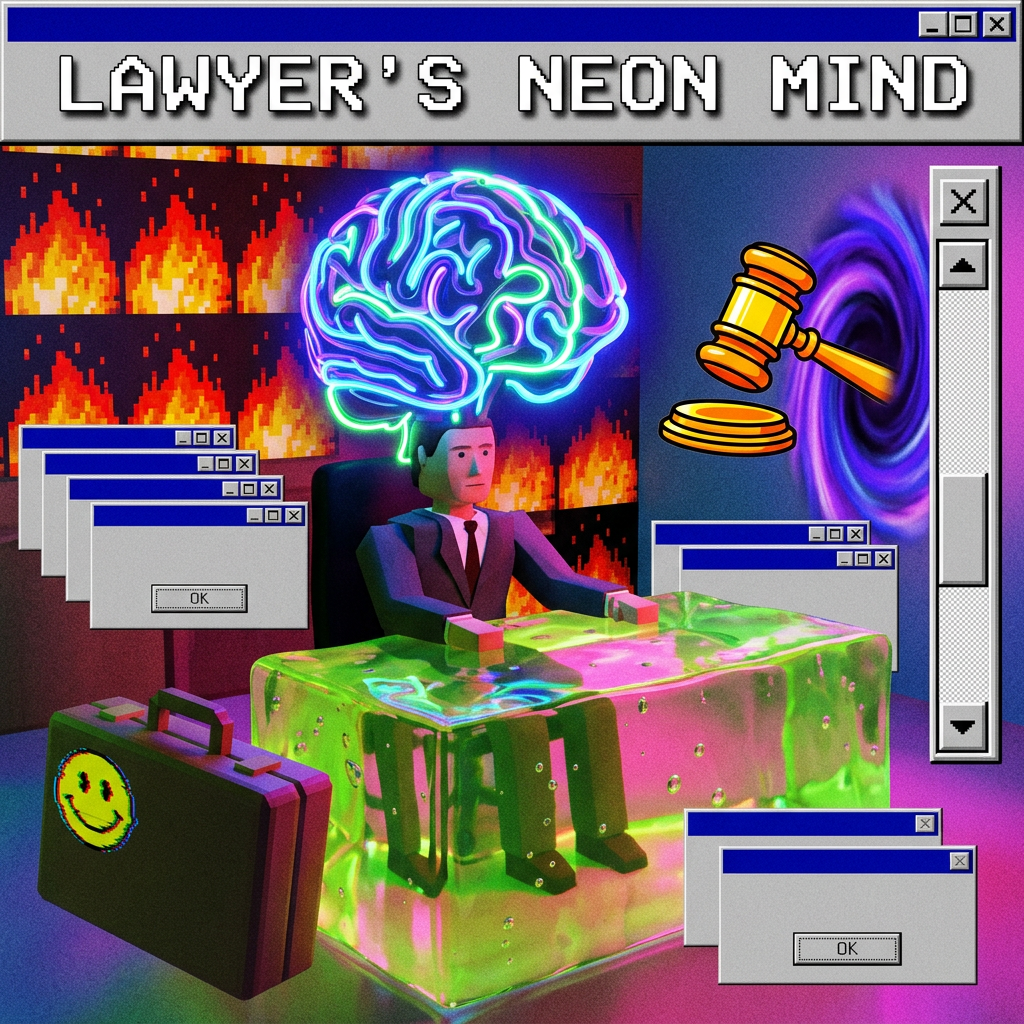
The Great Digital Shrug
Welcome to Legalweek, a place where people in expensive suits gather to feel relevant while desperately trying to understand what a 'large language model' actually is. The air is thick with the smell of overpriced coffee and the collective anxiety of ten thousand partners wondering if a chatbot is about to take their summer home. Every panel is just a room full of people nodding at a PowerPoint presentation while their brains slowly turn into static. They call it innovation, but it looks a lot like a group of people staring at a magic trick and trying to figure out where the coin went.
The buzzword of the year is AI. It’s not because the technology is revolutionary—though it is certainly better at lying than your average intern—but because it sounds better than 'we are still overcharging for basic research.' Everyone is talking about it in the hallways, at the happy hours, and probably in their sleep. It’s a performance of progress. If you say 'generative AI' three times in a mirror, a venture capitalist appears and hands you a check for five million dollars, even if you can’t explain how to attach a PDF to an email.
Billable Hours for Artificial Labor
Lawyers are traditionally about as tech-savvy as a Victorian-era chimney sweep. Now they are being told that a machine can summarize a deposition in three seconds. They aren’t worried about the ethics or the terrifying possibility of a machine becoming sentient; they are worried about how to explain to a client why a hallucinating bot costs four hundred dollars an hour. The industry is grappling with the fact that their entire business model is based on doing things slowly, and now the robots are doing things fast and poorly. It’s a match made in bureaucratic heaven.
There is a certain irony in watching a profession built on precision freak out over a tool that frequently makes things up. But then again, making things up and calling it an 'interpretation' is basically what the legal system is built on anyway. The AI isn't replacing lawyers; it's just automating the parts of the job that everyone hated, leaving more time for the parts of the job that everyone also hates, like talking to other lawyers. It’s a win-win for anyone who enjoys misery and high-speed data processing.
The Swag Graveyard
If you can ignore the existential dread of the AI hype, you can focus on the real reason people attend these things: the free stuff. The exhibition hall is a graveyard of branded plastic. Stress balls shaped like scales of justice, pens that will leak in your pocket, and tote bags that say 'The Future of Law' in a font that screams 'I was designed by a committee of people who haven't seen a sunset since 1994.' It’s a corporate carnival where the prizes are mediocrity and a LinkedIn connection you’ll ignore for the rest of your life.
The pitches at the booths are even more depressing. Every vendor claims their algorithm is the one that will finally make law firms efficient. It’s a bold claim for an industry that still uses fax machines in some jurisdictions. You watch the sales reps try to explain neural networks to men who still call their secretaries to 'Google the internet.' It’s a collision of worlds that shouldn't exist, like a Renaissance fair held inside a server room. Everyone is pretending to understand, because admitting you're confused is the only thing more expensive than the software itself.
Conclusion
Ultimately, the legal industry's embrace of AI is like a cat's relationship with a vacuum cleaner: deep suspicion masked by a desperate need to pretend everything is fine. Whether the robots take over the law or just get stuck in an infinite loop trying to define 'reasonable doubt,' the result will be the same—more billable hours for less actual thinking. I’m going to go stare at a wall now. It has more personality than a legal tech panel.