The Pivot to Everything Everywhere
So, the man who brought us the joy of surge pricing and the mystery of the ghost kitchen is back with a brand new bag. It is called Atoms. Not because he is a fan of high-school chemistry, but because he has realized that the physical world is much harder to delete than an app on a disgruntled driver's smartphone. Travis is folding CloudKitchens into this new monstrosity, effectively turning your midnight pad thai order into a R&D department for heavy machinery. It is a bold move, merging the world of dark kitchens with the world of robotics, mining, and transportation. It is the kind of synergy that usually only happens in the dreams of a venture capitalist who has been staring at a lava lamp for too many consecutive hours.
The logic is simple, or at least tech-bro simple. Why stop at delivering the food when you can own the robot that makes it, the robot that delivers it, and apparently, the robot that mines the lithium for the battery of the scooter that the robot uses? It is vertical integration taken to a level that borders on a Bond villain's retirement plan. Kalanick is betting that we want our future to be automated, anonymous, and probably served in a plastic container that was 3D printed in the back of an autonomous van.
Mining for Burritos
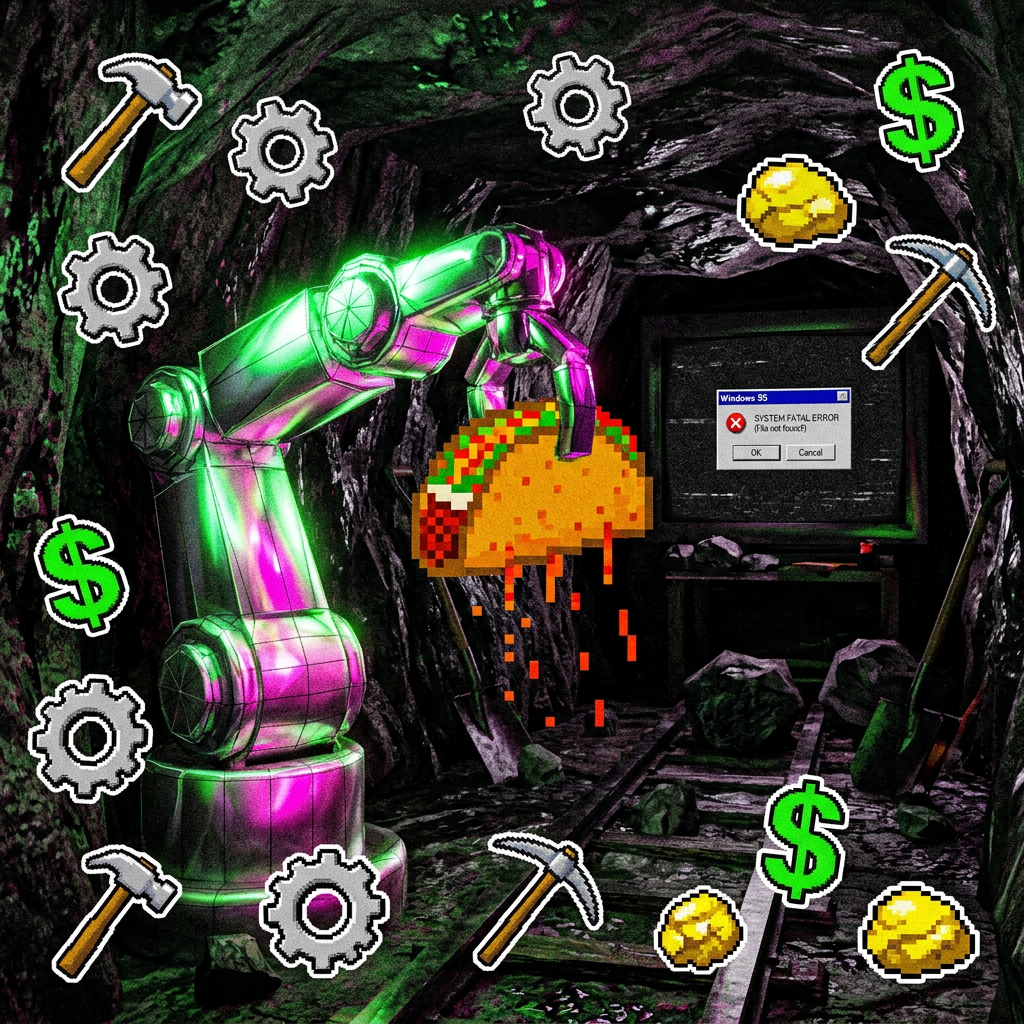
The most baffling part of this new venture is the mention of mining. Yes, mining. Because when I think of a guy who specialized in ride-sharing, my first thought is, 'I bet he knows his way around a subterranean cobalt vein.' It is an incredible stretch. One minute you are optimizing delivery routes for chicken wings, the next you are deploying autonomous drills into the earth’s crust. Maybe he is looking for the lost spice mines of Arrakis, or maybe he just realized that the real money isn't in the delivery fee, but in the rare earth minerals required to keep our digital addiction humming.
Imagine a world where your delivery driver is a six-legged mechanical spider that just finished a shift in a copper mine in Chile. It arrives at your door, smells faintly of sulfur and diesel, and hands you a bag of fries with cold precision. This is the 'Atoms' dream. It is a gritty, metallic future where the friction of human interaction is replaced by the smooth, unfeeling hum of a hydraulic press. If CloudKitchens was about hiding the source of your food, Atoms is about making sure that source is a cold, calculated line of code operating a jackhammer.
The Logistic Singularity
Transportation is the final piece of the puzzle. Kalanick is returning to his roots, but this time, he is ditching the messy human element entirely. No more awkward small talk, no more ratings systems for drivers who take the wrong exit. Just pure, unadulterated logistics. By combining these three sectors—food, mining, and transport—Atoms is positioning itself as the landlord of the physical realm. It is an ambitious attempt to control the flow of matter itself. If it has mass and it moves, Travis wants a piece of the action.
We are looking at a future where the line between a restaurant and a warehouse is completely blurred. A future where the earth is being hollowed out by robots just to make sure we can get a burger in under ten minutes without having to acknowledge another person's existence. It is efficient, it is terrifying, and it is exactly what happens when you give a billionaire enough time to think about how much he dislikes the limitations of human labor. Atoms isn't just a company; it is an attempt to rewrite the laws of supply and demand using heavy metal and proprietary algorithms.
Conclusion
At the end of the day, Travis is just playing a high-stakes game of Minecraft with real-world capital and our collective patience. Whether Atoms becomes the foundation of a new robotic empire or just another complicated way to lose money while disrupting the concept of a lunch break remains to be seen. But one thing is for sure: if a robot shows up at your door with a pickaxe and a lukewarm burrito, don't say I didn't warn you. The transition from bits to atoms is going to be a bumpy, grease-stained ride through the tectonic plates of the gig economy.