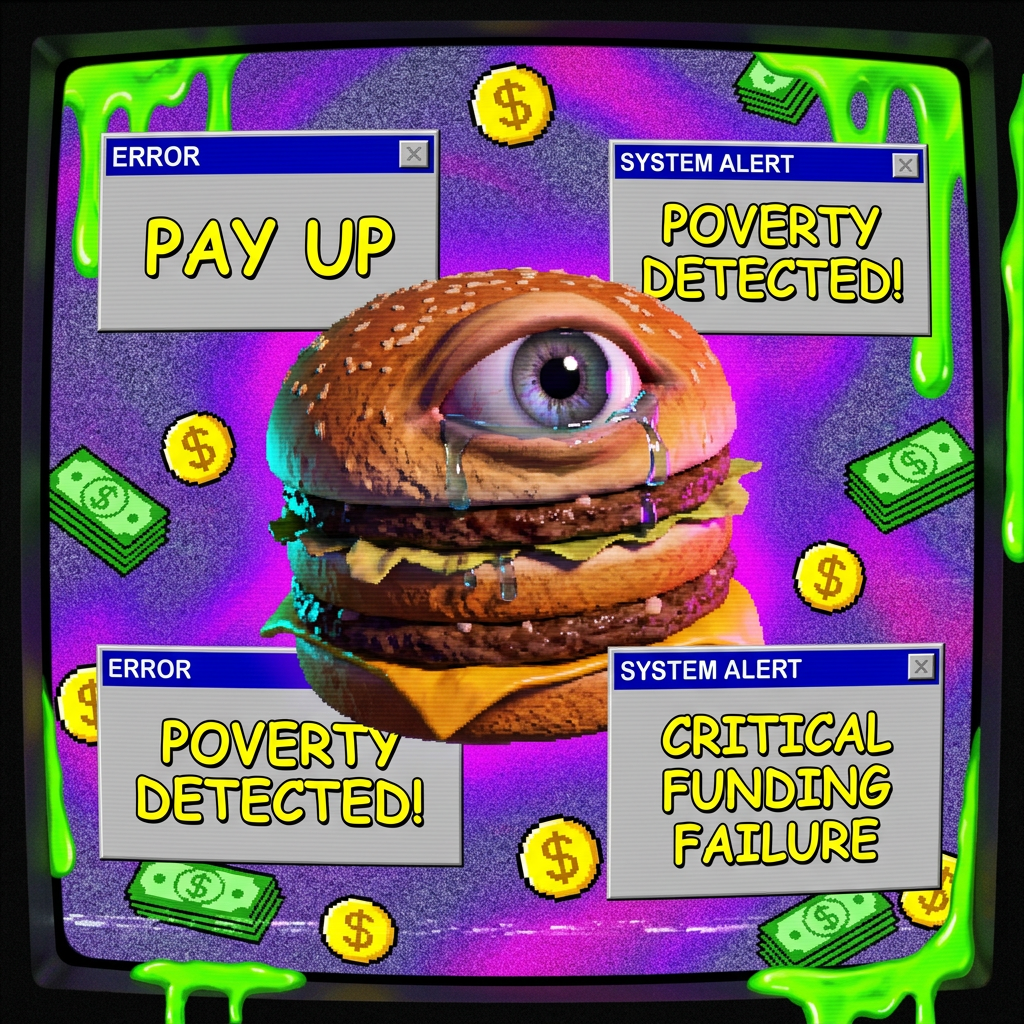
The Illusion of Choice in a Bun
There was a time, or so the history books written by optimistic liars suggest, when things had a set price. You walked into a store, looked at a tag, and decided if your dignity was worth that specific amount. Now, thanks to the wonders of 'surveillance pricing' and the fact that we’ve handed our lives over to apps, the price of a Big Mac is as stable as my interest in a school pep rally. It’s a chaotic lottery where the house always wins, and the house is a server farm in Silicon Valley that knows exactly how much you’re willing to bleed for a sesame seed bun.
Uber Eats has turned the simple act of ordering a burger into a psychological thriller. One minute it’s six dollars, the next it’s twelve, and suddenly there’s a 'small basket fee' because you didn't order enough poison to satisfy the algorithm's bloodlust. It’s not just delivery; it’s a social experiment to see how much we’ll tolerate before we finally learn how to boil an egg. Spoiler alert: the experiment is going very well for the billionaires, and we’re all failing the test.
Data Mining for Pickles
The most charming part of this modern economy is the 'surveillance' aspect. These apps aren't just taking your order; they’re taking your soul, or at least your battery percentage and GPS coordinates. Rumor has it that if your phone battery is at two percent, the price of your fries goes up because the algorithm knows you’re too desperate to shop around. It’s the digital equivalent of a vulture circling a dying animal, only the vulture is wearing a corporate logo and the animal is just a teenager who forgot to pack a lunch.
We’ve moved past supply and demand into a realm of pure, unadulterated exploitation. It’s 'dynamic pricing,' which is a fancy way of saying 'we’ll charge you whatever we think you’re too tired to complain about.' If it’s raining, you pay more. If you’re in a wealthy zip code, you pay more. If the algorithm senses even a hint of joy in your browsing history, it probably adds a 'happiness tax' just to keep the world balanced. It’s enough to make you miss the days when the only thing you had to worry about at McDonald’s was whether the ice cream machine was broken. Now, the machine is fine, but the price of a McFlurry is tied to the global carbon index and your own personal credit score.
The Convenience of Being Robbed
The ultimate irony is that we call this 'convenience.' We’re paying a premium to avoid the horrifying ordeal of interacting with another human being or, heaven forbid, walking three blocks. We are literally subsidizing our own social anxiety. The apps know this. They count on it. They’ve crunched the numbers and realized that a generation raised on screens would rather pay an 80% markup than have to speak to a cashier named Kevin about a promotional meal deal.
So, we sit in our dark rooms, watching the little car icon on the map move in circles while our bank accounts drain in real-time. We are the architects of our own financial ruin, one service fee at a time. Every time you accept a 'surge' delivery charge, a venture capitalist gets their wings, or at least a slightly larger yacht. It’s a beautiful system, really, if you happen to be the one holding the remote. For the rest of us, it’s just another day in the digital salt mines, where the salt is extra and costs an additional $1.50 per packet.
Conclusion
In the end, we’re all just lab rats in a digital cage, pressing a 'Deliver Now' button and hoping the shock doesn't hurt too much this time. The burger will be cold, the fries will be soggy, and the price will be a personal insult to your intelligence. But hey, at least you didn't have to put on pants or face the sun. That’s the dream, isn't it? A society so advanced we can pay twenty dollars for five dollars' worth of regret without ever leaving the couch. I’m going to go stare at a wall now. It’s free, for now.